There’s a rhythm most hotel groups operate on.
The month runs.
Operations happen.
Numbers get collected.
Reports get built.
Then leadership reviews performance—after the fact.
On paper, it works.
In reality, it creates one of the most overlooked inefficiencies in hotel operations today:
Waiting until month-end to understand what already happened.
The Illusion of Control

Month-end reporting gives the impression of control.
Clean financials.
Organized statements.
A complete picture of the business.
But that clarity comes at a cost:
Timing.
By the time reports are finalized, reviewed, and discussed, the window to influence those numbers has already closed.
Margins didn’t shrink at month-end.
Labor didn’t spike at month-end.
Operational inefficiencies didn’t suddenly appear at month-end.
They happened throughout the month—quietly, incrementally, and mostly unnoticed in real time.
✅ Pro Tip: Reporting that explains the past is valuable—but only if it helps influence what happens next.
Where the Delay Shows Up
Most hotel groups don’t realize how much this delay impacts decision-making because it’s built into the process.
A typical flow looks like this:
• Daily operations generate data
• Systems capture pieces of it (PMS, labor, accounting)
• Finance consolidates at month-end
• Leadership reviews performance days—or weeks—later
Each step makes sense independently.
But collectively, it creates lag.
And in hospitality, lag compounds.
A Scenario Many Groups Recognize

Consider a multi-property hotel group reviewing performance in the second week of the following month.
The report shows:
• Labor costs exceeded target at several properties
• Margins tightened despite strong occupancy
• One or two locations underperformed expectations
The questions come quickly:
What happened?
Was this a one-time issue?
Is it already corrected?
The challenge is that no one is answering these questions in real time.
Managers may have felt the pressure during the month—tight staffing, unexpected demand, operational friction—but by the time it shows up in financial reporting, it’s already historical.
Now the conversation shifts from:
“How do we fix this?”
to:
“Why did this happen?”
And more importantly:
“Is it still happening?”
The Compounding Cost of Delay
The real cost of waiting isn’t just slower reporting—it’s missed opportunity.
When performance issues aren’t visible early, they continue longer than they should.
A few extra labor hours per day turns into weeks of elevated costs.
Small inefficiencies across departments stack into measurable margin pressure.
Underperforming properties drift further before anyone steps in.
None of these issues are catastrophic on their own.
But together, they create a pattern:
Decisions lag behind reality.
And when decisions lag, performance follows.
✅ Pro Tip: Most operational problems aren’t difficult to solve—they’re difficult to see early enough.
Why This Happens
It’s not because hotel groups don’t care about performance.
It’s because the systems they rely on weren’t designed to align timing.
Brand systems show operational data quickly.
Accounting systems prioritize accuracy over speed.
Labor tools track activity, but not always in context.
Each system answers a different question—on a different timeline.
So even when data exists, it doesn’t exist in a way that supports timely decisions.
The result:
Managers operate in real time.
Financial insight arrives later.
Leadership connects the two after the fact.
What Changes When Timing Improves
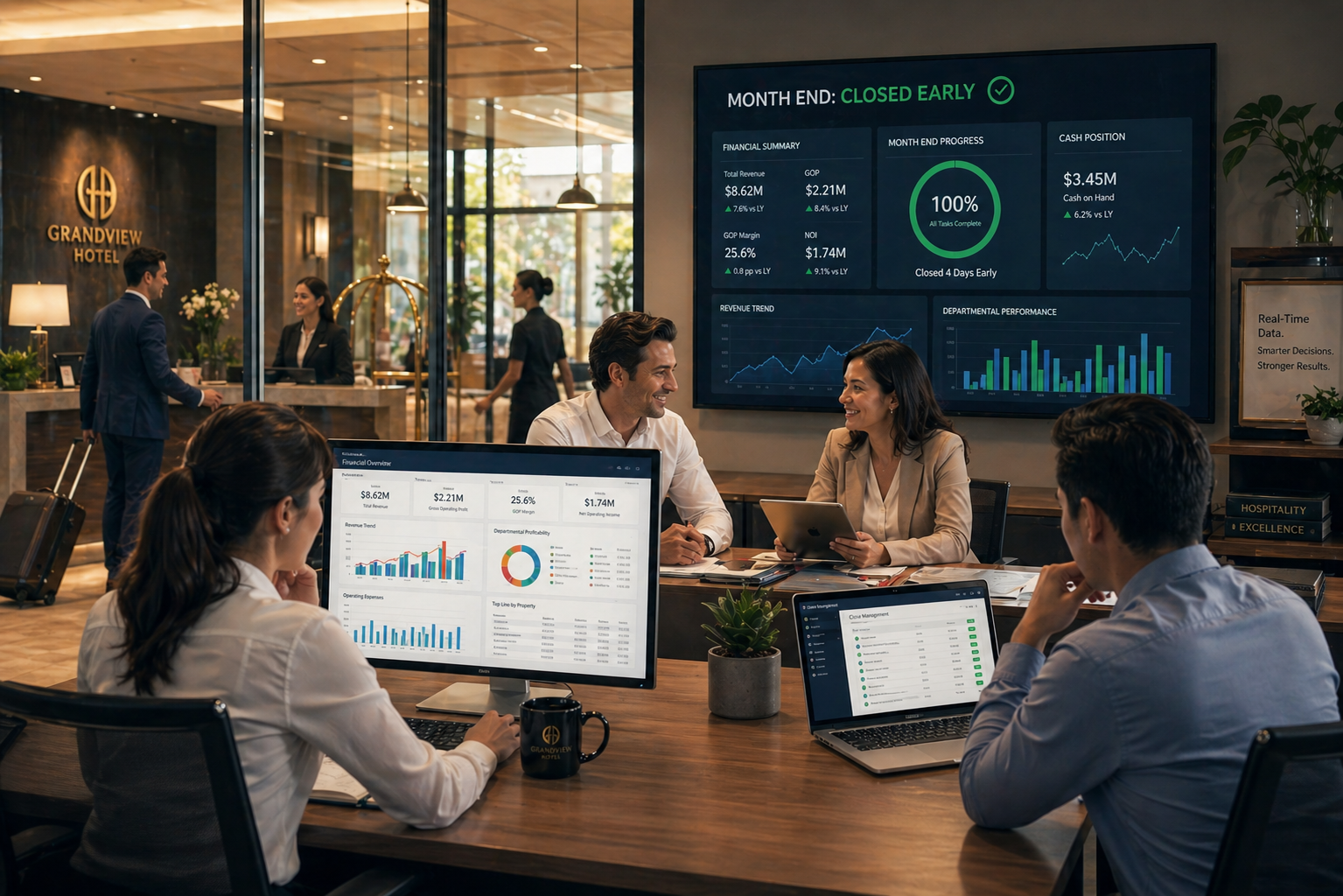
When hotel groups reduce the delay between operations and insight, something subtle—but powerful—happens.
Conversations shift.
Instead of asking:
“What happened last month?”
They start asking:
“What’s happening right now?”
That shift changes behavior.
• Labor adjustments happen mid-week, not after month-end
• Performance issues are addressed while they’re still small
• Managers operate with context, not just intuition
• Leadership spends less time reconciling and more time directing
The goal isn’t faster reporting for the sake of speed.
It’s better timing for better decisions.
A Different Way to Think About Reporting
Most hotel groups think about reporting in terms of completeness.
Is the data accurate?
Is everything reconciled?
Is the report finalized?
But the more important question is:
Is it still actionable?
Because a perfectly accurate report that arrives too late doesn’t improve performance—it just explains it.
The Bottom Line | Timing Drives Performance
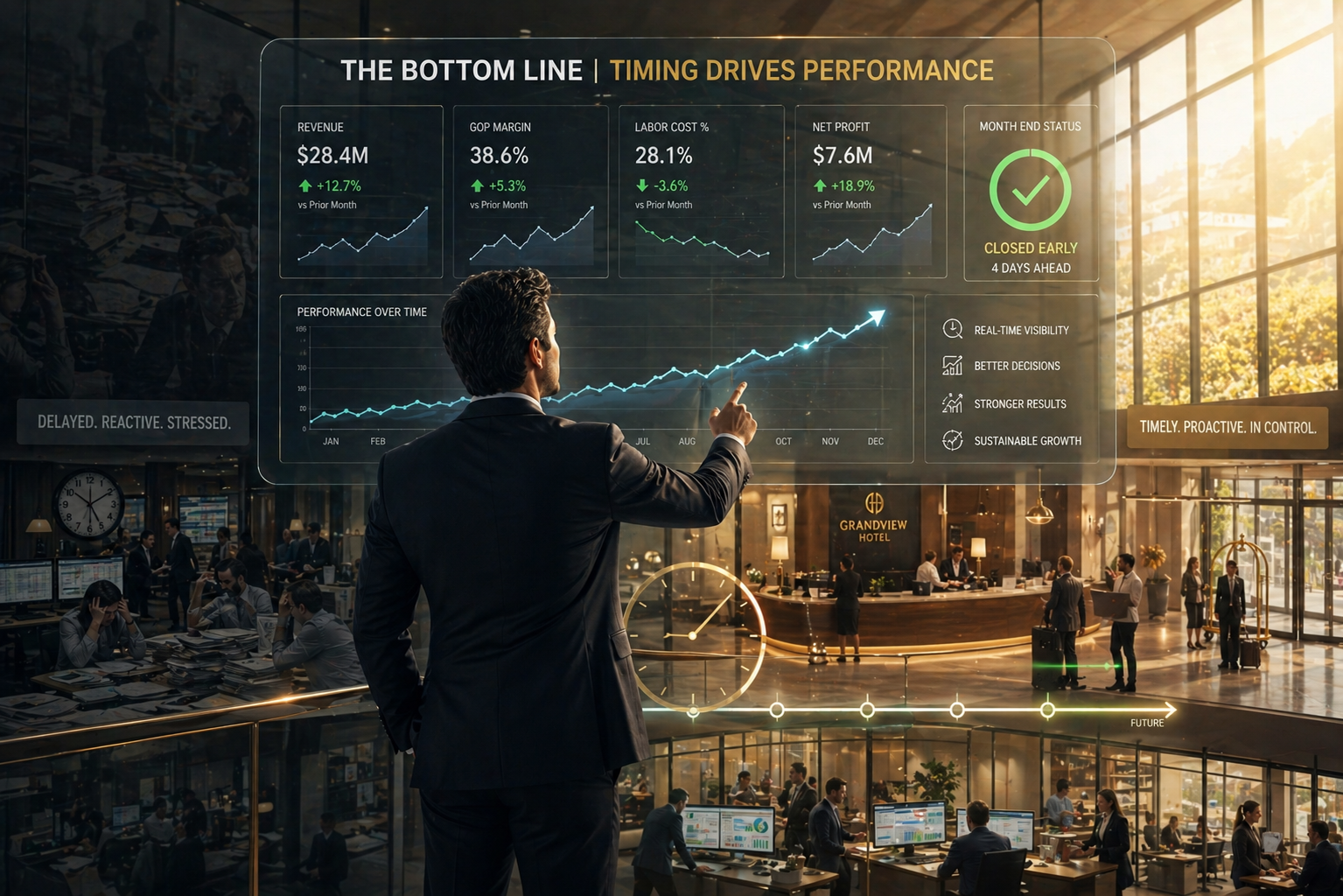
Hotels don’t operate on monthly cycles.
They operate daily—hour by hour, shift by shift.
But many decisions are still guided by information that arrives weeks later.
That gap between when something happens and when it’s understood is where performance is won or lost.
The hotel groups that close that gap don’t just move faster.
They operate with more clarity, make more confident decisions, and correct issues before they compound.
Because in today’s environment, it’s not just about having the right data.
It’s about having it at the right time.
✅ Pro Tip: If your reports explain what happened last month, but don’t help you influence what’s happening this week, the timing—not the data—may be the real issue.